

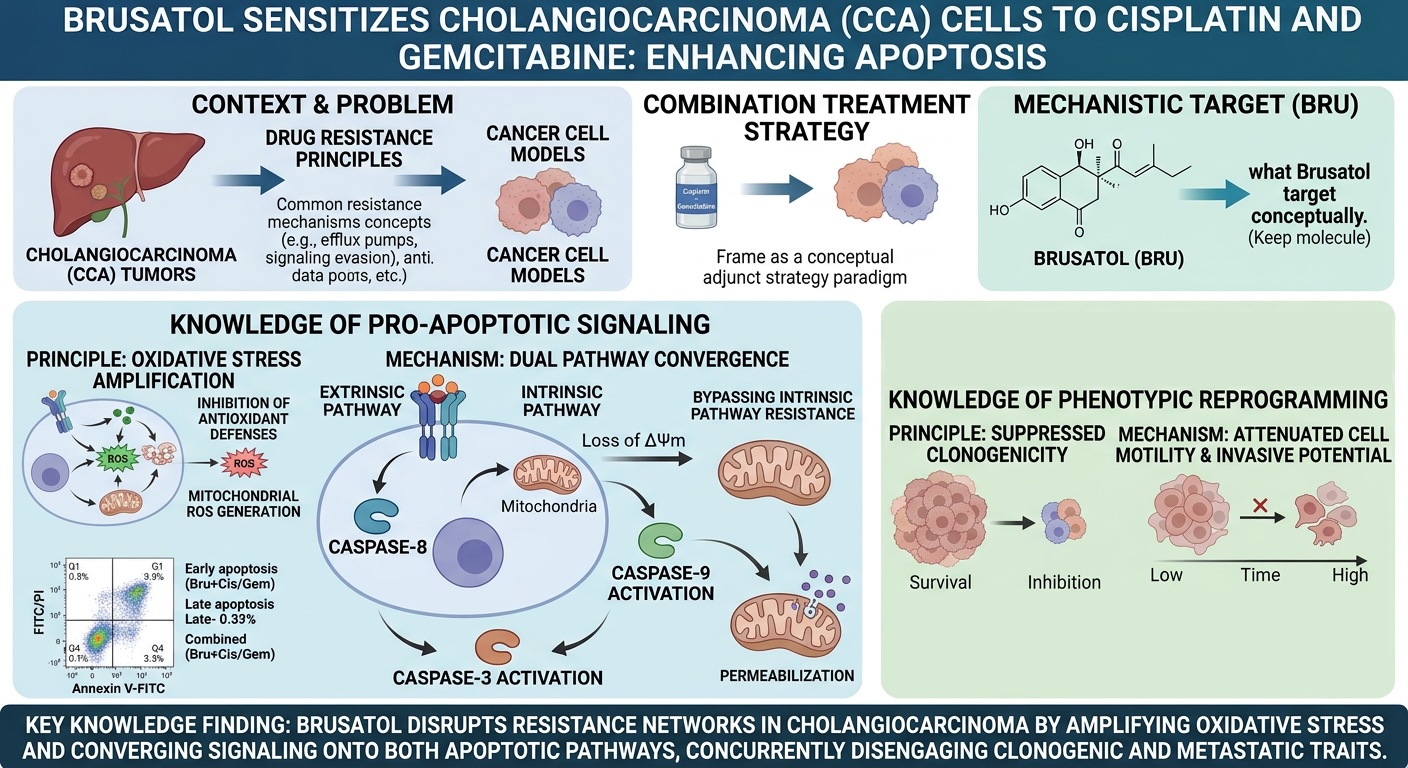
Cholangiocarcinoma (CCA), a cancer of the bile duct, is a major health problem in the Mekong basin region, including northeastern Thailand. It is difficult to diagnose, so most patients are found at an advanced stage when surgery is no longer possible. The standard chemotherapy, cisplatin combined with gemcitabine, often loses its effect because the cancer cells become drug resistant, and the cancer can also spread to other organs. This study asked whether brusatol, a natural compound from the plant Brucea javanica, could help these standard drugs work better in human CCA cells (KKU-100).
We found that brusatol reduced the viability of CCA cells in a dose- and time-dependent manner. When it was combined with cisplatin or gemcitabine, the drugs killed more cancer cells than when used alone. The combinations raised the level of reactive oxygen species (ROS) inside the cells, and an antioxidant (N-acetylcysteine) reduced the killing effect, showing that ROS are important for this action. The combinations also caused loss of mitochondrial membrane potential and increased the activity of caspase-3, -8 and -9, indicating that both the intrinsic (mitochondrial) and extrinsic (death-receptor) apoptosis pathways were activated. The effect depended on the drug partner: brusatol with cisplatin was about additive to slightly synergistic (combination index 0.97), whereas brusatol with gemcitabine was antagonistic by this measure (combination index 1.42).
In addition, the combinations strongly reduced the ability of surviving cells to form colonies and suppressed cell migration and invasion, which are key steps in cancer spread. Together, these results suggest that brusatol is a promising anticancer agent or adjunct to current chemotherapy for CCA. Further studies in animal models are needed before clinical use.
มะเร็งท่อน้ำดี (CCA) เป็นปัญหาสุขภาพสำคัญของประชากรในภูมิภาคลุ่มน้ำโขงรวมถึงภาคตะวัน ออกเฉียงเหนือของประเทศไทย โรคนี้วินิจฉัยได้ยาก ผู้ป่วยส่วนใหญ่จึงพบในระยะลุกลามที่ไม่สามารถผ่าตัดได้ ยาเคมีบำบัดมาตรฐานคือซิสพลาตินร่วมกับเจมซิตาบีนมักมีประสิทธิภาพลดลงเนื่องจากเซลล์มะเร็งดื้อยา และมะเร็งยังแพร่กระจายไปอวัยวะอื่นได้ การศึกษานี้จึงทดสอบว่าบรูซาทอล (brusatol) สารธรรมชาติจากพืช Brucea javanica จะช่วยเสริมฤทธิ์ของยามาตรฐานทั้งสองชนิดในเซลล์มะเร็งท่อน้ำดีของมนุษย์ (KKU-100) ได้หรือไม่
ผลการศึกษาพบว่าบรูซาทอลลดการมีชีวิตของเซลล์มะเร็งท่อน้ำดีตามขนาดความเข้มข้นและระยะเวลาที่ได้รับ เมื่อใช้ร่วมกับซิสพลาตินหรือเจมซิตาบีน ยาร่วมสามารถทำลายเซลล์มะเร็งได้มากกว่าการใช้ยาเดี่ยว โดยทำให้ระดับอนุมูลอิสระออกซิเจน (ROS) ในเซลล์เพิ่มขึ้น และสารต้านอนุมูลอิสระ (N-acetylcysteine) ลดฤทธิ์การทำลายเซลล์ดังกล่าว แสดงว่า ROS มีบทบาทสำคัญ นอกจากนี้ยังทำให้ศักย์เยื่อหุ้มไมโทคอนเดรีย ลดลงและเพิ่มกิจกรรมของเอนไซม์แคสเปส-3, -8 และ -9 บ่งชี้ว่ามีการกระตุ้นกระบวนการอะพอพโทซิสทั้ง ทางไมโทคอนเดรียและทางตัวรับความตาย ทั้งนี้ผลขึ้นกับชนิดของยาที่ใช้ร่วม คือ บรูซาทอลกับซิสพลาติน ให้ผลใกล้เคียงการเสริมฤทธิ์กันถึงเสริมฤทธิ์เล็กน้อย (ค่า combination index 0.97) ขณะที่บรูซาทอลกับ เจมซิตาบีนให้ผลต้านกัน (combination index 1.42)
ยิ่งไปกว่านั้น การใช้ยาร่วมกันยังลดความสามารถในการสร้างโคโลนีของเซลล์ที่รอดชีวิตอย่างชัดเจน และยับยั้งการเคลื่อนที่และการรุกรานของเซลล์มะเร็ง ซึ่งเป็นขั้นตอนสำคัญของการแพร่กระจาย ผลการศึกษา นี้ชี้ว่าบรูซาทอลมีศักยภาพเป็นสารต้านมะเร็งหรือยาเสริมการรักษาด้วยเคมีบำบัดในมะเร็งท่อน้ำดี แต่ยังต้อง ศึกษาต่อในสัตว์ทดลองก่อนนำไปใช้ทางคลินิก
Reference
Khunluck T, Inson I, Chutoe C, Senggunprai L, Prawan A, Lertsuwan K*. Brusatol enhances the chemotherapy efficacy of Cisplatin and Gemcitabine in KKU-100 cholangiocarcinoma cells through ROS-mediated apoptosis. Sci Rep. 16: 28862.
Relevant SDGs

BC investigator