Red-shifted D-luciferin analogues and their bioluminescence characteristics

Red-shifted D-luciferin analogues and their bioluminescence characteristics

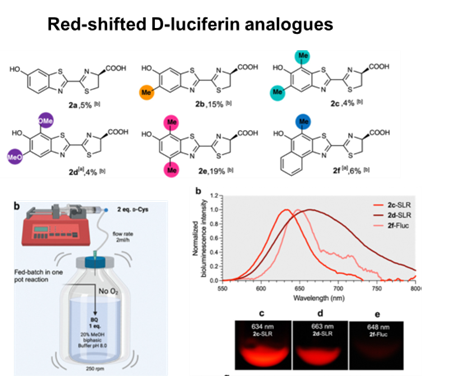
        D-Luciferin (D-LH2) is the most widely used substrate for beetle luciferases in bioluminescence applications. Here, we synthesized six D-LH₂ analogues, including the novel 5’,7’-dimethoxy-D-LH₂ and 7’-methylnaphthol-D-LH₂, and developed a continuous one-pot green synthesis that improved luciferin yields 63-fold over previous methods. The analogues were evaluated with five luciferases (Fluc, SLR, Eluc, Pmluc-WT, and Pmluc-N230S) and all produced, red-shifted bioluminescence relative to D-LH₂ (480 nm). Notably, 5’,7’-dimethoxy-D-LH₂ with SLR yielded the longest emission wavelength (663 nm). The 5’-methyl-D-LH₂ analogue emitted brighter and longer-wavelength light than D-LH₂ with all luciferases except Eluc, while 5’,7’-dimethyl-D-LH₂ showed prolonged emission with slower decay. In mammalian cells expressing Fluc, SLR, or Pmluc-N230S, 5’-methyl-D-LH₂ enabled 11.2-fold higher sensitivity for Fluc detection in HEK293T lysates than D-LH₂, and 5’,7’-dimethyl-D-LH₂ exhibited high sensitivity for live-cell imaging using red-light detection. These analogues are promising substrates for sensitive cell-based assays and real-time bioluminescence imaging.

        ดี-ลูซิเฟอริน (D-LH₂) เป็นสารสับสเตรตของเอนไซม์ลูซิเฟอเรสที่ใช้กันอย่างแพร่หลายในงานตรวจวัดด้วยเทคนิคการวัดการเรืองแสง ในงานวิจัยนี้ เราได้พัฒนากระบวนการสังเคราะห์แบบต่อเนื่องในขั้นตอนเดียวที่เป็นมิตรต่อสิ่งแวดล้อม ในการสังเคราะห์สารอนาล็อกของ D-LH₂ จำนวน 6 ชนิด ซึ่งมี 2 ชนิดเป็นสารใหม่ ได้แก่ 5’,7’-ไดเมทอกซี-D-LH₂ และ 7’-เมทิลแนฟทอล-D-LH₂ โดยวิธีการสังเคราะห์แบบใหม่นี้ได้ช่วยเพิ่มผลผลิตของลูซิเฟอรินได้ถึง 63 เท่าเมื่อเทียบกับวิธีการก่อนหน้านี้ สารอนาล็อกเหล่านี้ได้รับการประเมินด้วยเอนไซม์ลูซิเฟอเรส 5 ชนิด (Fluc, SLR, Eluc, Pmluc-WT และ Pmluc-N230S) และทั้งหมดให้การเรืองแสงที่มีคุณสมบัติเป็น red shifted หรือแสงสีแดงเมื่อเทียบกับ D-LH₂ (480 นาโนเมตร) ทั้งนี้ 5’,7’-ไดเมทอกซี-D-LH₂ เมื่อใช้กับ SLR ให้ความยาวคลื่นการปล่อยแสงที่ยาวที่สุด (663 นาโนเมตร) ส่วน 5’-methyl-D-LH₂ ปล่อยแสงที่สูงกว่าและมีความยาวคลื่นมากกว่า D-LH₂ เมื่อใช้กับเอนไซม์ลูซิเฟอเรสทุกชนิด ยกเว้น Eluc ในขณะที่ 5’,7’-dimethyl-D-LH₂ แสดงการปล่อยแสงที่ยาวนานขึ้นและมีการสลายตัวที่ช้าลง จากการทดลองใช้ลูซิเฟอรินที่สังเคราะห์ได้ในเซลล์สัตว์เลี้ยงลูกด้วยนมที่แสดงออก Fluc, SLR หรือ Pmluc-N230S พบว่า สาร 5’-methyl-D-LH₂ ทำให้ความไวในการตรวจจับ Fluc ในสารละลาย HEK293T สูงกว่า D-LH₂ ถึง 11.2 เท่า และ 5’,7’-dimethyl-D-LH₂ แสดงความไวสูงสำหรับการถ่ายภาพเซลล์มีชีวิตโดยใช้การตรวจจับแสงสีแดง ดังนั้นสารของลูซิเฟอรินเหล่านี้จึงเป็นสารตั้งต้นที่มีศักยภาพสำหรับการทดสอบแบบใช้เซลล์ที่มีความไวสูงและการถ่ายภาพการเรืองแสงในเซลล์แบบเรียลไทม์

Reference

Watthaisong P, Kantiwiriyawanitch C, Jitkaroon W, Phintha A, Klayparn I, Lawan N, Kamutira P, Sasaki D, Visitsatthawong S, Maenpuen S, Tinikul R, Sucharitakul J, Nishihara R, Niwa K, Nakajima Y, Ohmiya Y, Chaiyen P. Red-shifted d-luciferin analogues and their bioluminescence characteristics. RSC Chem Biol. 2025, 7, 67-80.

Doi: 10.1039/d5cb00287g

Relevant SDGs

SDGs_Goal-3

BC investigator